
Experimenting with my simulator, I arrived at what is, to put it mildly, an interesting discovery.
For as long as airsoft has existed, AEG tuning has relied on that formula for the optimal ratio of cylinder volume to barrel volume, the one that gives the best use of the spring’s power for a given BB weight:
ratio = 7.5 × bb_weight² + 1.55
A replica built to that ratio will run just fine, but it will exhibit the “compression bounce” I wrote about earlier. Near the very end of the stroke, the spring is no longer strong enough to resist the pressure that has built up in the cylinder – so the piston bounces back a few millimetres before it gets moving again and strikes the cylinder head. That energy turns into the sound we hear as the piston slam.
Thinking about how to avoid it, I discovered that if you take a cylinder with a very specific port – one considerably below the volume this formula would give you – something interesting happens: the piston then settles smoothly onto the cylinder head instead of slamming into it. The result is a quieter replica – not a silent one, because the slam doesn’t vanish entirely; rather, as we’ll see below, it gets delayed and softened.
Three zones
Looking at the chart of BB energy versus cylinder volume, we can see three zones: a red one with too little volume, a narrow blue one I named the “Quiet” zone, and the green “Regular” zone. Alongside the BB energy I’ve also plotted the total piston-slam energy (every impact until it settles, including the delayed one), because only together do they show what’s really going on.
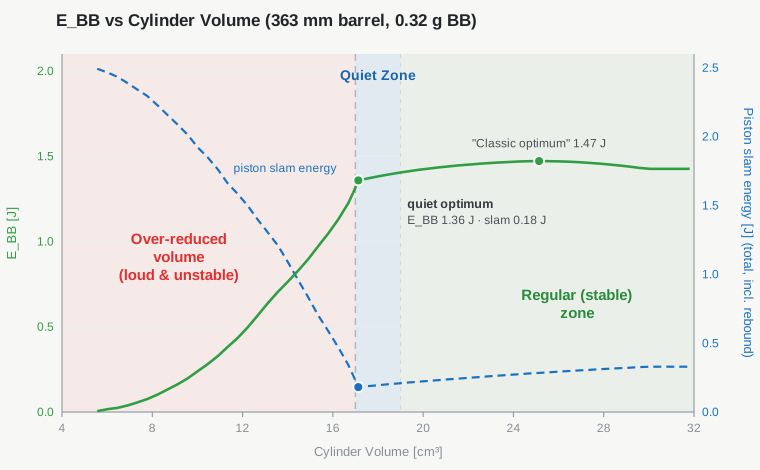
In the red zone the volume is too small: the air can’t take up the spring’s energy in time, the piston strikes the head at full force (over 2 J!), and the BB gets crumbs. Nothing to look for there.
The interesting part begins at the border with the blue zone. There the air cushion in front of the cylinder head stops the piston almost perfectly softly – but the story doesn’t end there: the pressure built up in the cylinder shoves the piston back while the BB is still in the barrel. Part of that energy returns to the spring, and part is spent along the way on friction and heat. Once the BB exits and the pressure vents, the spring pushes the piston forward again and it – now for the second time – settles onto the head. But that second impact no longer carries the spring’s full run-up, only what was left after the bounce-back, so it’s quieter than with regular tuning: on my test configuration around 0.19 J, versus the 0.22 to 0.33 J the classic optimum carries. The price of that quiet is about 0.1 J of energy on the BB.
The catch is that in a real-world scenario this point is hard to hit. It depends on quite a few parameters that are difficult to measure accurately (such as the volume inside the cylinder head and the nozzle itself – the length of that “dead passage”, which is critical for this tuning), the hardness of the sorbo pad, and even tiny variations in the exact moment when the piston head O-ring catches and starts creating compression. And the chart shows why a miss is costly, too: the blue zone is narrow, and immediately to its left is a wall – the slam jumps sharply and the energy drops. The result is a replica that runs more quietly, but with less consistent energy than a conventionally tuned replica – something I have also verified experimentally.
On the other hand, in the green regular zone we have the classic optimum where the power curve is quite flat, so variations in the aforementioned parameters between two shots don’t affect the output energy as much – but the piston impact is louder for it.
How Auto-Tune finds it
That’s why the simulator’s Auto-Tune offers, alongside standard tuning (maximum energy), a Quiet tuning too: it searches through port positions and finds the point where the total piston slam is quietest – summed over every impact, including the delayed return one.
It deliberately doesn’t put the recommendation exactly at the minimum. The slam minimum sits right up against that wall, so even a small error in drilling the port or in the measured dead volume could tip you over it. That’s why there’s a “Port safety margin”: the recommended port is shifted from the minimum by a set margin (1 mm by default) towards the larger port – away from the wall, onto the gentle side of the curve. That safety costs just a few mJ of slam, but it guards against a costly miss. Alongside the recommendation, Auto-Tune also prints the sensitivity [J/mm] – the steepness of that very wall – so you know exactly what that margin is leaning on.
Realistically, this Quiet zone could be put to use with a hard sorbo pad, an ideal O-ring, and a cylinder that’s regularly lubricated.