
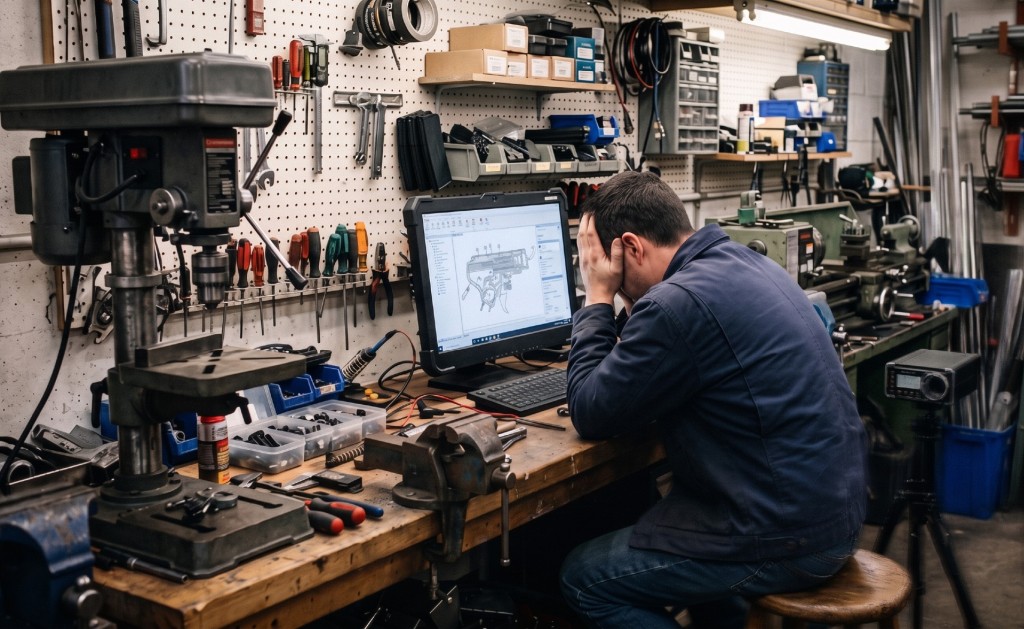
When I set out to tune my first replica – geek that I am – I made a point of thoroughly studying whatever I could dig up about it on the internets.
One of the first things I found was the famous formula for the optimal ratio of cylinder volume to barrel volume, depending on BB weight:
ratio = 7.5 × bb_weight² + 1.55
The story behind the formula goes roughly like this. A long-time forum regular going by the handle 1tonne measured the volume ratios for various BB weights, and others spent years passing his findings around the airsoft forums (the trail goes back to at least 2015 on the Airsoft Sniper Forum). In August 2018 he also published a full write-up, What Barrel Length goes with what bb weight in an AEG, describing the experiment – an AEG with a full cylinder and a 550 mm barrel, which he cut down 10 mm at a time, chronographing the energy for every BB weight at each step.
The formula itself, however, wasn’t his. In April 2017 a user named heregoeshell on the Airsoft Sniper Forum took 1tonne’s tabulated data and fitted a quadratic curve through it – using, as he put it, an eyeball rather than a statistical method – with a note that the result could be off by up to 10%. That caveat, of course, got lost somewhere along the way, and the formula lives on: to this day it gets quoted around the forums as if it were the word of the Almighty.
I first grew suspicious of the formula while working with barrels under 250 mm, where my measured results strayed quite a bit from its predictions; a barrel cut to the recommended length delivered less power than one a centimetre or so longer. Also, with barrels that were too short, the power refused to climb when I switched to a heavier BB – even though, according to the formula, it should have!
The catch is that 1tonne, however honestly he documented his procedure, measured everything on a single configuration: one piston, one bucking, one spring. The table – and the formula later drawn from it – silently assumes exactly that hardware. Piston mass, which in my experience has a real effect on output power, doesn’t appear in the math at all; barrel diameter gets no more than a passing mention; the hop-up he re-tuned by eye for every BB, “to fly as flat as possible”. And the dead space in the passage through the cylinder head and the nozzle, which changes how the energy is delivered to the BB, doesn’t even get a mention… My gut also told me that even the spring’s power ought to have some effect on the efficiency.
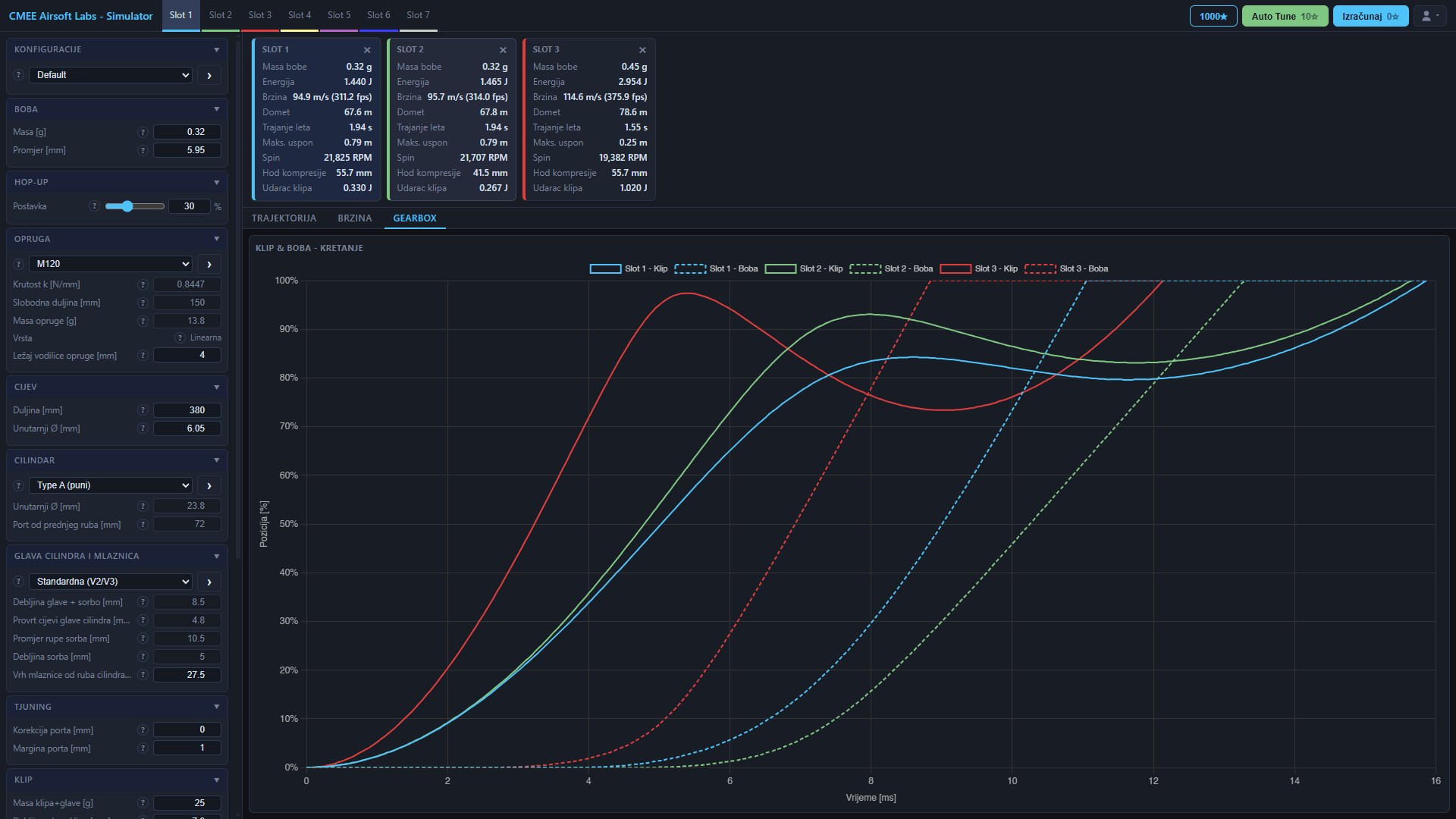
So in the end I decided to write out every parameter and physical process I could think of that might play a part in what happens inside the compression side of a replica – and to start building a program to simulate it. I calibrated the theory by tuning the physical parameters against my own exact, strictly controlled measurements, and cross-checked the results against outside research and references.
After a few months of intensive work, I had a model that deviates from my measurements only minimally. That finally gave me a window into processes inside the replica that had been invisible until then. The program lets me predict how any given parameter will affect the BB’s velocity, range and trajectory without tearing the replica apart – along with things I could never measure before, like how hard the piston slams. And perhaps the most interesting part of all – it let me watch the motion of the piston and the BB in detail, and that led me to some completely new and unexpected conclusions!
Time well spent – and the result the airsoft community will, I hope, get at least a little mileage out of!