
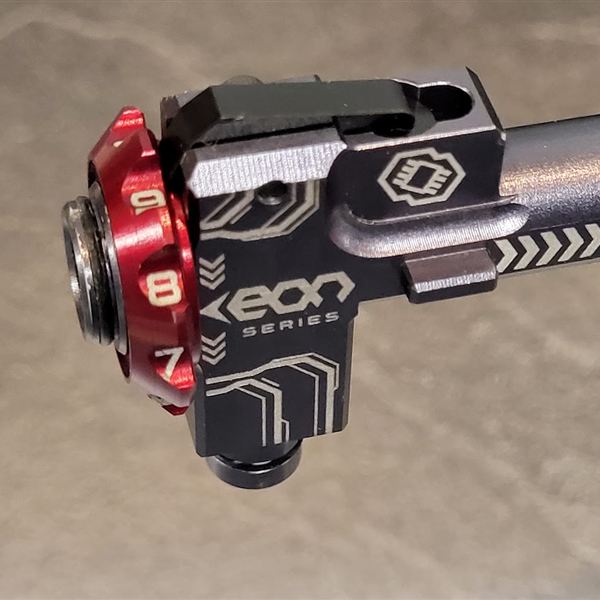
The hop-up is a rubber bucking at the top of the barrel’s entry that presses on the BB and gives it backspin. That spin generates lift (the Magnus effect) and makes the BB fly considerably farther than it would without it. It’s adjusted with a wheel or a lever, usually where the dummy bolt or ejection port sits.
Not a measurement – a setting
There’s nothing to measure on a hop-up: it’s a setting you turn until the trajectory looks the way you want. In the Lab it’s entered as a percentage, and the scale is defined through the optimal trajectory: 30 % is the setting that gives a 0.32 g BB its optimal rise (~70 cm), and 40 % is the same thing for a 0.45 g BB. Zero means hop off.
Where to enter it
In the simulator: Hop-up → setting (%).
Among the advanced settings there’s also the hop-up patch length – feel free to leave it at the default 5 mm.
How much hop?
Example of a tuned ~1.5 J assault replica with 0.32 g BBs:
- no hop: a mere ~34 m of range
- “flat” trajectory: ~55 m
- ~70 cm rise: ~66 m – the BB climbs just above your sight line so you can track it the whole way; this is the setting I personally use
- overtightened: past 70 m, but the BB escapes your field of view – in practice useless for aiming
Matching your real replica
The wheel on the replica has no meaningful scale, so it works the other way around: in the simulator, set the percentage so the trajectory rise matches what you see in the field. The best way to set the hop-up is so the BB in flight climbs above your point of aim to the highest point at which you can still aim effectively.
Conveniently, the rise doesn’t depend on spring power – the trajectory is a matter of hop, speed and BB mass, so once found, the setting survives a spring change.
Note: the percentage scale is tuned to a Maxx chamber with an r-hop. With a regular hop-up bucking you’ll need to tighten considerably more to get the same trajectory – and that’s exactly why the hop correction factor exists: it maps the scale onto your chamber and bucking, so the percentages mean what they’re supposed to again.
An r-hop, thanks to better friction, delivers more spin with less pressure, and on top of that it’s more consistent and less sensitive to the bucking’s temperature – which is why silicone r-hops beat a classic rubber bucking hands down.