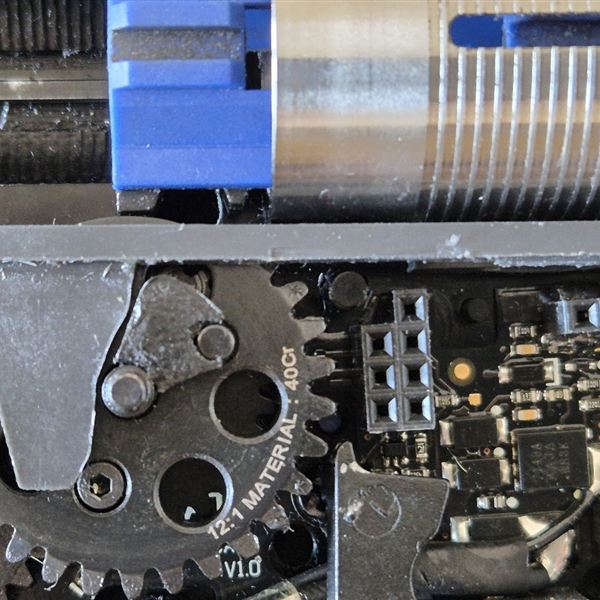
The cylinder determines how much air the piston has available to launch the BB. The types differ by port position – the little window in the cylinder wall: compression only starts once the piston seal passes the port, so a port closer to the head means a smaller working volume.
The one basic input
Cylinder type – in the Lab you pick a preset: full (TypeA), ported TypeB or TypeC, bore-up, plus dedicated variants for V7 and SR-25 gearboxes. Bigger volume goes with longer barrels, smaller with shorter ones. The TypeB and TypeC presets refer to SHS and Point cylinders – with other manufacturers the port position varies quite a bit, so for those you should measure the port distance from the front edge precisely and enter it manually.
Where to enter it
In the simulator: Cylinder → preset.
Which type do I have?
Easiest way: look at where the port is. A full cylinder has no port (or it sits all the way at the rear), TypeB has it around the middle, TypeC closer to the front end. Manufacturers also often engrave the intended barrel-length range on the cylinder (e.g. 300–400 mm).
But careful: the TypeB and TypeC presets are valid for SHS and Point cylinders. With other manufacturers the “same type” can have the port in a noticeably different spot – for those, measure the port distance and enter it manually.
Bore-up cylinders have a larger inner diameter (24.7 instead of the standard 23.8 mm) and get their own preset.
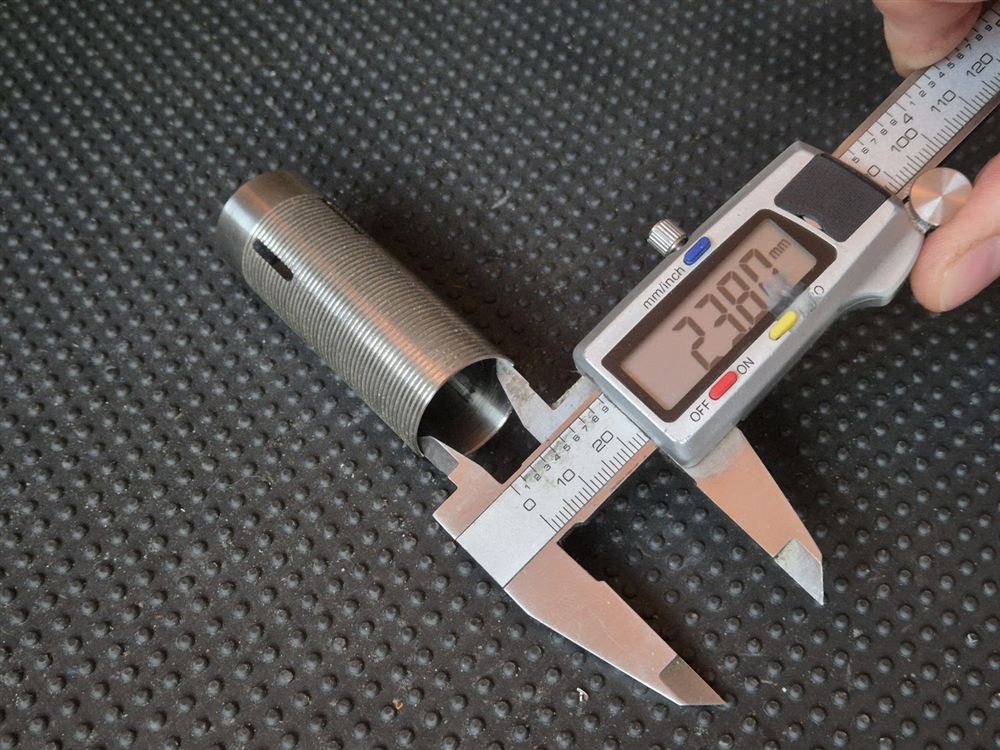 Inner diameter: the standard 23.80 mm.
Advanced: custom port
If your cylinder doesn’t match any preset, you can enter the port position manually: measure the port distance from the front edge of the cylinder – tape measure or calipers, to the nearest millimetre is plenty.
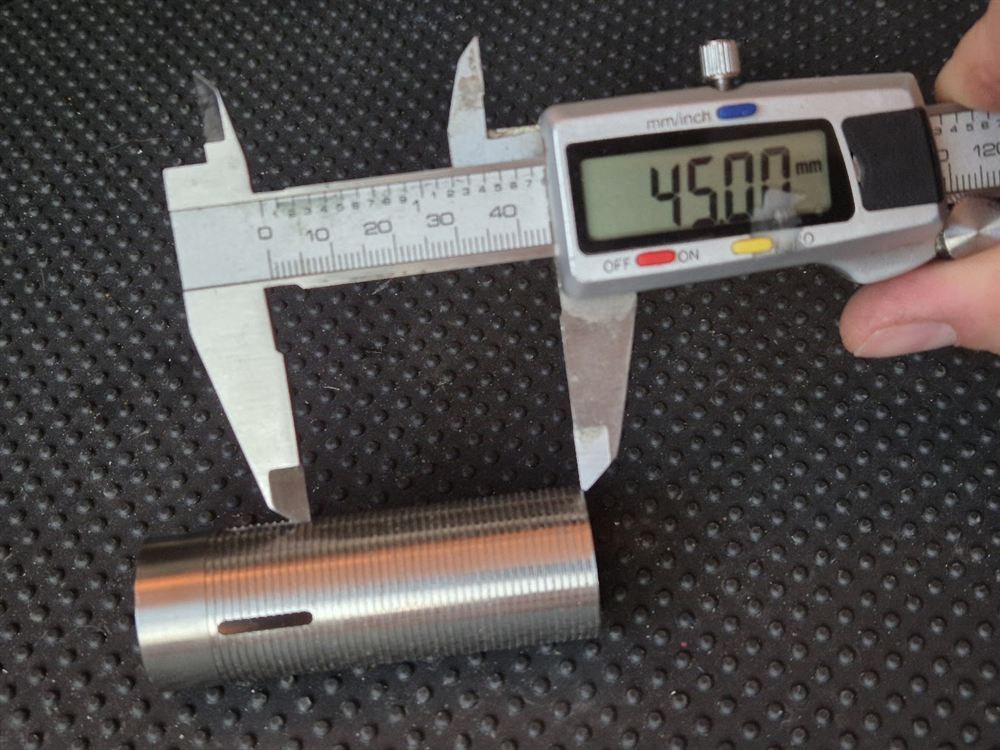 Port distance from the front edge: 45 mm – TypeC.
There’s also the port correction – a forward shift of the port for re-porting. As a rule you don’t touch it manually: Auto-tuning suggests it when computing the ideal cylinder for your combination.
The port margin is the extra margin the auto-tuner will leave so the port doesn’t get shortened too much. With sub-volume tuning the boundary is razor-sharp, and cutting a hair too much gets you the opposite effect. The result also depends heavily on the dead-space length, which is relatively hard to measure accurately – and for sub-volume tuning it’s critical. For 99 % of users I still recommend the “normal”, stable tuning.
Auto-tuning: two tuning points
You don’t have to guess which cylinder is “right” for your setup – Auto-tuning computes that for you. And it offers two points, because the chart of BB energy versus cylinder volume has two zones:
The Regular zone is the classic optimum: the power curve there is quite flat, so small shot-to-shot variations (O-ring, lube, sorbo) don’t affect the output energy much – but the piston impact is clearly audible.
The Sub-Volume zone ends with a steep cliff, and right at its top the piston lands softly on the cylinder head, handing the energy that would have gone into the slam – to the BB. The result is a super-quiet replica that also delivers more power! The catch: in the real world that point is hard to hit. It depends on parameters that are difficult to measure accurately (the volume inside the cylinder head and the nozzle, the hardness of the sorbo pad, even the exact moment the piston O-ring “catches”), and the curve around the optimum is very steep – so the replica runs quieter, but energy consistency is lower than with conventional tuning.
More in the Sub-Volume zone article.