
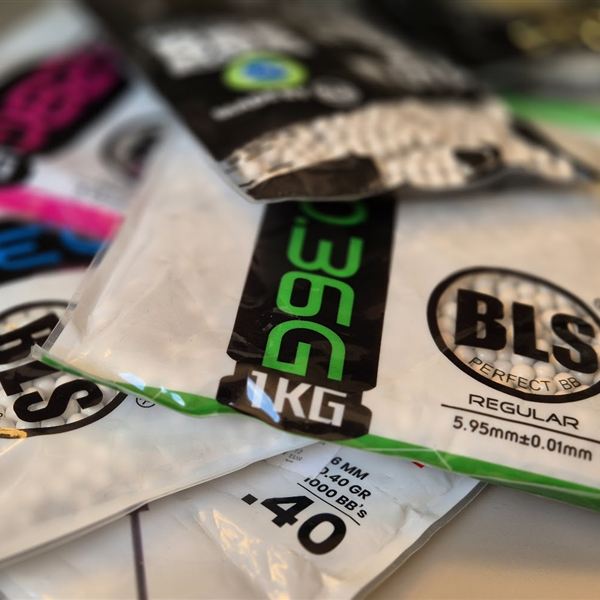
BBs are easy. The two basic numbers you just copy off the packaging and move on.
The two basic numbers
- Mass – printed on the packaging (e.g. 0.28 g, 0.32 g…).
- Diameter – although BBs are nominally “6 mm”, the real diameter is deliberately made a touch smaller, usually 5.95 mm – and that too is printed on the packaging. Just copy it across.
No measuring, no calipers – it’s all on the box.
Where to enter it
In the simulator: BB → mass / diameter.
Quality pays off
Mass, and even shape, vary from BB to BB – and how much depends on quality. Better BBs mean smaller deviations, and smaller deviations mean tighter groups, so accuracy and range improve automatically.
That’s why you should always go better rather than cheaper. It’s better to fire a few good ones and hit, than to empty a mag of bad ones that fly every which way – and then wonder why the jackass over there won’t call his hits.
Advanced: drag coefficient (Cd)
For those who want to go deeper: Cd sets how much the air slows the BB in flight. The Lab has ready-made presets for it – feel free to leave them on default.
- Plastic airsoft BB: Cd = 0.50
- Ideal, perfectly smooth sphere: Cd = 0.47
- Dimpled airsoft BB: Cd = 0.35
The latter two are here just because. You will actually use just the first one.
Curiosity: a BB with golf-ball “dimples” has nearly half the drag – the dimples reduce the air vortices that slow it down, so the range would be dramatically longer. The catch is that such a BB is very hard to manufacture; there was once a commercial attempt, ultimately abandoned. More about it here